The need: bringing different home systems into one experience
A smart home user should not need to understand every device’s technical specification. They need to know which room is being heated, which lights are on and when an automation will run. The application we developed for BtiHome aimed to make home management more organised and accessible.
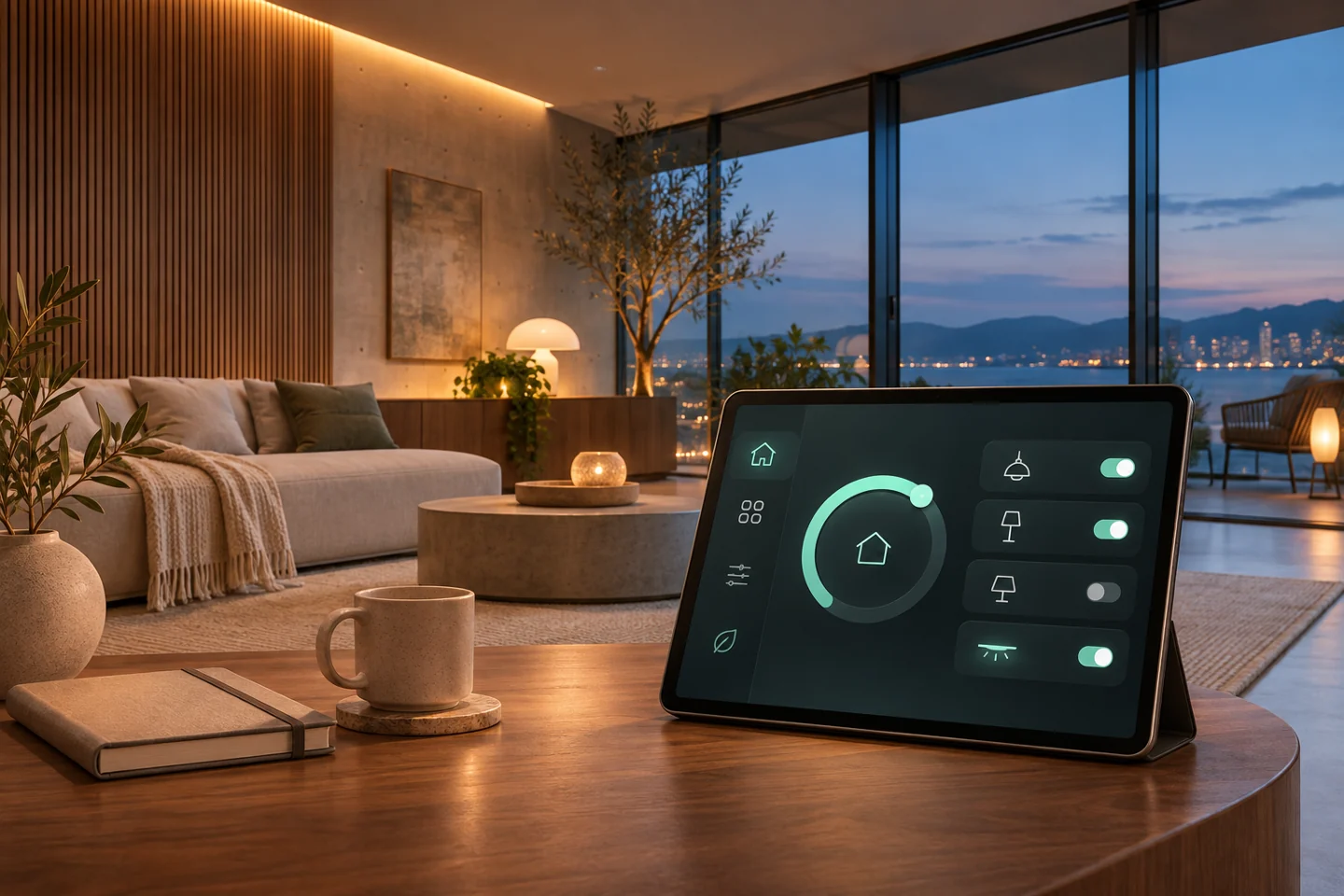
The scope included home management, heating and cooling, lighting and the organisation of other home automations. It is an example of our custom software and application development working with physical systems. Device control, interface design and automation logic need to be considered together.
Rooms, devices and scenes: an understandable control model
A device list alone is not always a sufficient interface. People think in terms of rooms: living room lighting, bedroom temperature or systems to turn off when leaving home. Rooms, device groups and automation scenes are useful concepts for structuring a smart home experience.
BtiHome focused on organising climate control and lighting within a home management context. Comparable applications distinguish scheduled actions, manually activated scenes and condition-based automations. Showing which devices a scene will affect makes the action easier to understand.
The engineering behind climate and lighting controls
A target temperature and a measured temperature represent different information. The same is true of a lighting command and a device’s reported state. This distinction matters when a command is pending, a device is offline or the last reported state is stale. The interface should not imply more certainty than the system has.
Event-driven communication, device-state synchronisation and command acknowledgement are relevant concepts in IoT software. MQTT, HTTP APIs, local gateways and manufacturer services are possible integration options, depending on the hardware. The right integration must be selected with the devices and control requirements in mind. BtiHome’s work centred on organising and controlling the home management experience.
Balancing automation with user control
More automation rules do not automatically create a better experience. What should happen when a user manually turns a light off? How long should a temperature override remain active? How should conflicting actions be handled? These are product design questions as well as technical ones.
Time zones, connection failures, background application behaviour and device reconnection are additional considerations. Because home management affects the physical environment, permissions, safe defaults and device-side protections matter. Software automation complements rather than replaces the equipment’s safety mechanisms.
What smart home engineering teaches about digital products
BtiHome illustrates the work required to turn different technical systems into one understandable product. An action that appears to be a single button can depend on state models, integrations and automation rules. Smart home development therefore involves more than screen design.
Our Köprü Mezun web and mobile platform demonstrates this product-centred thinking in another context. SeekCivoAI explores operational automation. Talk to us about a smart home management application, IoT dashboard or mobile product.
Turn your idea into a working solution.
Tell us about your project ↗