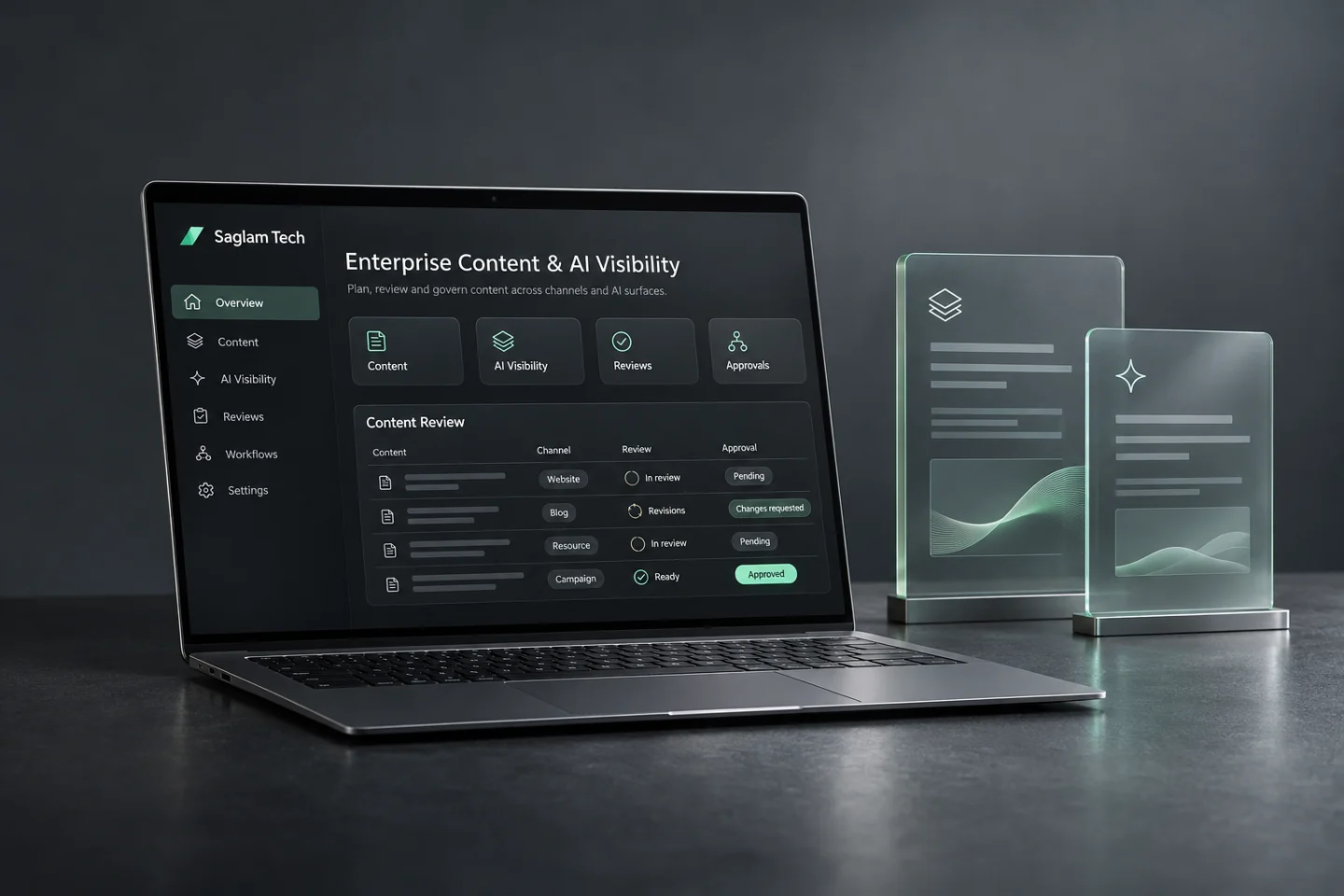
Visibility starts with a useful answer to the right question
A business looking for a technology partner will not always search for a brand name. It may describe a need: custom software development, a document-based AI assistant, a smart home application or Ansible infrastructure automation. A useful corporate website connects those questions to specific services and real project experience. That relationship between the visitor’s question, the page topic and the proposed solution is the foundation of SEO.
At Saglam Tech, we approach SEO and AI visibility as a shared discipline across content, engineering and measurement. The aim is not simply to publish more pages. It is to make accurate information easier to find, understand and reference.
Technical SEO: a foundation that makes content accessible
Well-written content still needs an accessible technical foundation. Crawlable HTML links, consistent URLs, an appropriate canonical address, unique page titles and descriptions, XML sitemaps and mobile usability should be considered together. Broken links, unnecessary redirects and overlapping pages can weaken the content structure.
A project case study should lead naturally to the relevant service. Our Borgmain LLC AI assistant project connects to AI automation, while SeekCivoAI infrastructure automation illustrates DevOps engineering. Link text should tell readers what they will find next.
What AI visibility and GEO / AEO involve
AI visibility means understanding how a brand or its content appears in AI-powered answers and improving its discoverability. GEO and AEO are terms used for work in this area. There is no universal file or single technique that guarantees selection across every model. Google’s AI search features and other AI platforms also have different approaches to access and source selection.
Accurate company information, clear service descriptions, original project accounts and current sources provide the content foundation. Concise answer summaries, descriptive headings and complementary articles help readers and information extraction workflows. Structured data should describe the content that people can actually see on the page.
Using project articles and customer references responsibly
Case studies make broad service descriptions concrete. What was needed, what was delivered and which engineering decisions mattered? İzlek’s content and visibility platform is one example. Sector-specific content can also be explored through CAN-EL’s project news and technical guides and Marmix’s natural stone collections.
External links provide useful context and a route to the original source. Linking to a customer does not, by itself, guarantee a ranking improvement. We use these links to explain the work and complete the reader’s understanding, rather than to construct an artificial link network.
Measuring the right evidence
Organic impressions, clicks, relevant search queries, indexing status and qualified enquiries can contribute to SEO evaluation. AI measurements also need the question, model, language, market, date and method. A brand mention and a correct citation for the relevant service are different observations.
Failed answers or answers without verified search activity should not distort a success-rate denominator. Missing data should not be labelled zero success. İzlek’s evidence-based measurement approach is designed to preserve these distinctions. An editorial change alone cannot guarantee a ranking, an AI citation or a sale.
Where to begin
Start by clarifying your services and your audience’s questions. Build a clear service page, support it with genuine case studies and expand the topic through practical guides. After publication, review technical problems and performance consistently. Our technical SEO, content strategy and AI visibility service helps businesses establish that process.
Further reading: Google Search Essentials, link best practices and Google’s AI search guidance.
Turn your idea into a working solution.
Tell us about your project ↗